


Five questions every media architect should ask before adding another tool

Most media tech stacks aren’t designed. They’re accumulated. A new AI service here. A render engine there. A review platform layered on top. On paper, the stack looks modern. In reality, when editing handoffs, localisation pipelines, review cycles and MAM integrations collide under pressure, it behaves like a legacy system. Every new addition creates a new point of fragility, and orchestration gets bolted on later instead of being part of the design. The issue isn’t the tools. It’s the absence of orchestration as a design principle from day one.
The following five questions reveal where your workflows are actually vulnerable. Make sure to ask them before you add anything new.
Question 1: What happens when this tool fails mid-workflow?
New tools like AI processing, versioning systems and metadata enrichment get plugged in without any failure handling built in. So when the tool crashes or times out, the entire pipeline just stops. No rollback, no rerouting, nobody gets notified.
In real production environments, this is how it shows up: An overnight render fails at 2am, but no one realises until the morning’s review when the footage isn’t there. Or an AI transcription job stalls halfway through; half the content is captioned and half isn’t. Sometimes it’s even more basic than that, like the wrong version getting sent for client review as there’s no automated checkpoint between editorial and delivery.
In a resilient workflow, failures trigger automatic retries, reroute to alternate services, notify the right people and keep work moving without human intervention. Without that, all you've added is capability, not resilience.
.avif)
Question 2: How long does it take to get value from a new tool?
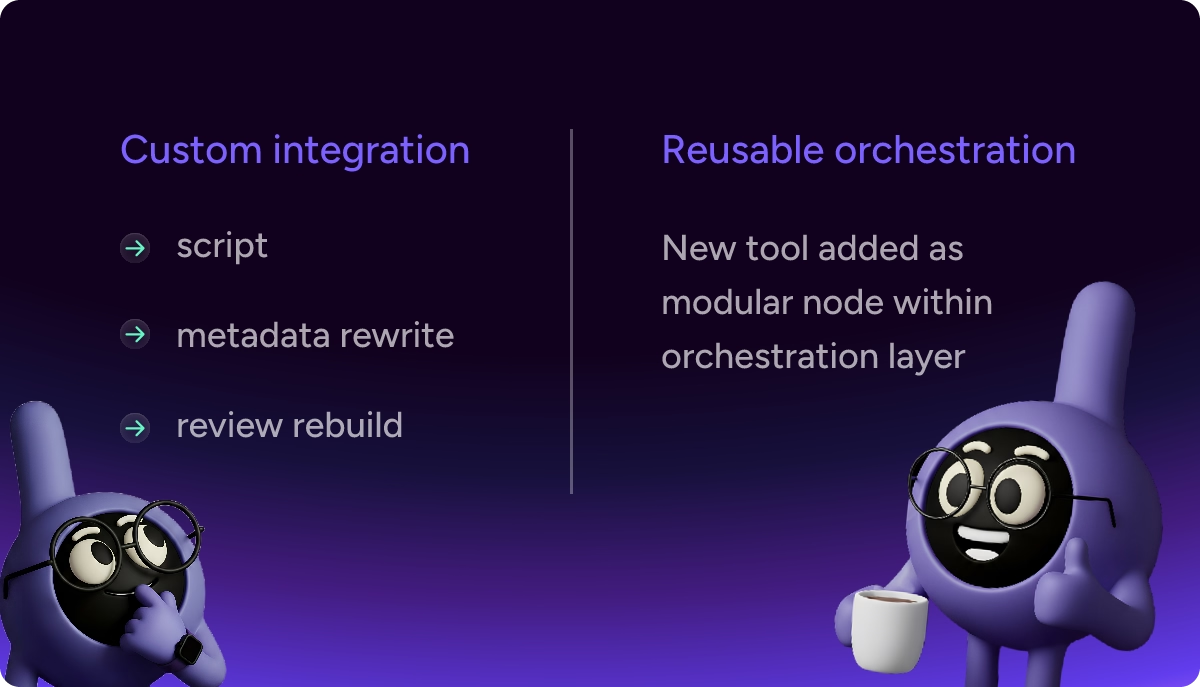
You don’t adopt a new tool out of a love of experimentation. You adopt it because a client, a deadline, or a new requirement forces you to. Integrating new technology such as AI captioning, a new rendering engine or cloud storage rarely means simply plugging in a new service. It involves custom scripting, metadata mapping and weeks of testing across edit, render, review and archive. Innovation becomes slow and costly. By the time something is live, it is often already outdated, or the vendor has changed their API.
Say, you’re testing a new AI dubbing service for a single title. Connecting it to your existing pipeline, however, means writing custom integration code, as well as aligning language and version metadata. Not to mention defining review paths for editorial and localization teams, and adding human approvals before anything can move forward. The result? What should really be a quick experiment takes a month just to trial.
The friction isn’t just technical. It is operational. Asset and version management, metadata-driven routing, review workflows and sign-offs all have to be rebuilt for every new tool. Editors wait for jobs to appear. Localization teams wait for the right versions. Operations waits for everything else to line up.
Without a standardized orchestration layer, every addition becomes a one-off integration project. If integrating a new AI service still means writing scripts, rebuilding metadata logic and redefining review paths from scratch, the architecture itself is the bottleneck. In that environment, experimentation doesn’t just slow down. It becomes risky.
Question 3: Where does the business logic actually live?
Workflow logic is scattered. Some lives in scripts, some in tool configurations, some deep in your coworker's head. When priorities change, like in a rush job, a compliance update or a new delivery spec, you can't adapt quickly because there's no single source of truth.
A client needs multiple language versions with different review paths for each region. The logic for conditional branching lives in three different places: one script handles localisation routing, another manages review approvals and a third coordinates final delivery.
What should really be automatic takes you days to implement.
The complexity compounds with production workflows: version rules, localisation branching, review approvals, metadata-driven routing and platform-specific deliverables. When the logic isn’t centralised or visible, every change means you need to hunt through systems. You end up with workflows that can’t scale or evolve without nonstop human checks.
Question 4: Can you trace a single asset from ingest to delivery?
Visibility ends at tool boundaries. You know what each system is doing, yes. But what about what’s happening between them? When something goes wrong, you're making guesses at where it broke. There’s no audit trail, origin or accountability.
An asset goes missing between QC and archive. What’s behind it? Could be encoding. Or transfer. Or metadata. But you're checking logs across five separate systems manually.
The real issue isn't just logs. It’s the absence of workflow state as a first-class concept. An asset leaves editorial, goes through AI enrichment, hits localisation and finally lands in review. But no single system owns the full journey and every step in the process is a potential failure point beyond your sightline. Without orchestration tracking state across systems, visibility ends at tool boundaries.
The journey should be totally traceable all the way through, with a clear audit trail at each step: ingest, edit, render, QC, review and approval, localisation, archive. Without that visibility, you’re managing tools, not workflows.
Question 5: What happens to your workflows when people leave?
Workflows are often built on siloed expertise. The person who built them maintains them, and when that knowledge isn’t documented or versioned, even small changes become risky.
The engineer who set up your editorial automation left the company six months ago. Now there's a new compliance requirement and nobody knows how to modify the localisation routing or review approval logic without breaking everything.
This isn't just about people leaving. It's about governance. Workflows should be documented, versioned and maintainable so operations don't depend on one engineer's scripts. Without that, you've built a dependency on people instead of on reliable processes.
Stop stitching tools together. Start designing workflows.
If you can’t answer these five questions with complete confidence, your stack is more fragile than it seems. If workflows can’t adapt, recover, and stay visible from start to finish, you don’t have a scalable media supply chain. You have a collection of fragile toolchains.
Orchestration isn't a nice-to-have that gets added later. It's the design principle that makes everything else work. When orchestration is built in from the beginning, new tools integrate cleanly, failures are handled automatically, and workflows adapt without teams constantly stepping in to keep things moving.
This is exactly why qibb was built as an orchestration-first platform for media workflows. qibb doesn't just connect your tools. It provides the orchestration layer that allows your workflows to be resilient, completely traceable and adaptable without custom scripting or undocumented knowledge.
Want to pressure-test your production and post workflows against these five questions? Let’s map your current pipeline and identify where orchestration can eliminate fragility.

qibb today


What is a media iPaaS, and why do media teams need more than generic integration tools?

Media workflow automation vs orchestration: what’s the difference and why it matters
How media teams can measure sponsorship value from live event footage
Five questions every media architect should ask before adding another tool
How policy automation prevents workflow failures in media operations
From elections to major sports events: how orchestration helps newsrooms stay ahead during live events
How media teams can add new AI tools without breaking their workflows
How agentic workflows change the game for overstretched media operations in sports
IBC 2025 proves it: AI works, but workflows hold it back
Low-code, no-code, or custom development: what works best for your media workflows?
How a European broadcaster saved over €80,000 in one year with qibb’s media workflow orchestration platform